Key Takeaways
- Third-party logistics (3PL) is outsourcing the physical side of selling products (receiving, storage, picking, packing, shipping, and returns) to a provider that never takes ownership of your inventory.
- 3PL providers range from ecommerce fulfillment specialists to freight-focused and asset-based operators, while a 4PL sits a level above, coordinating several 3PLs across a wider supply chain.
- A 3PL lets a growing brand absorb volume jumps and seasonal peaks without adding warehouse space, staff, or equipment of its own.
- The main drawbacks of outsourcing fulfillment to a 3PL are less hands-on control, onboarding time and setup costs, integration work, and reliance on the provider’s performance.
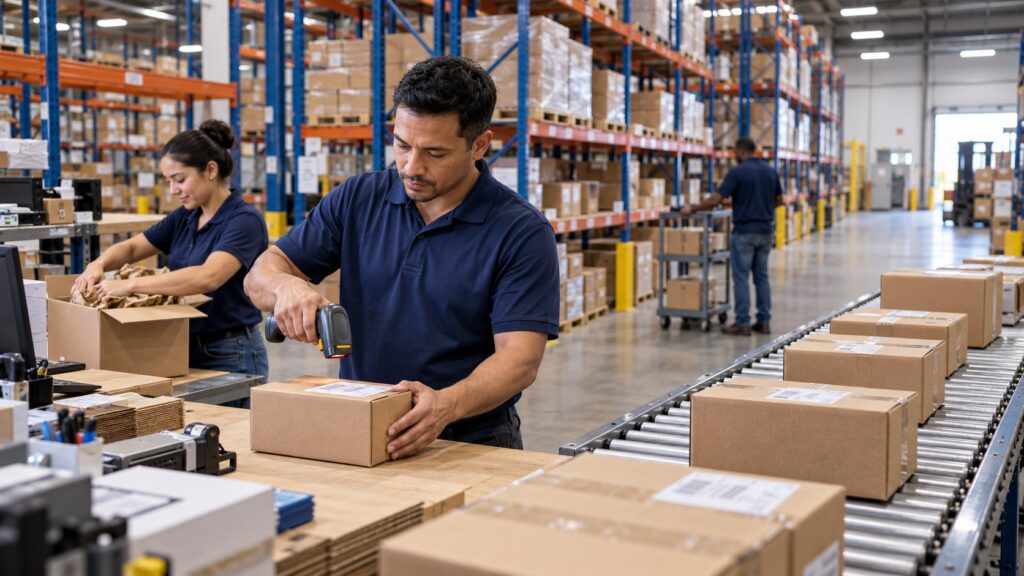
A 3PL, or third-party logistics provider, is an outside company that stores your inventory and picks, packs, and ships your orders so you don’t have to. That’s the short answer to “what is 3PL?” The longer one matters if you’re deciding whether to hand off fulfillment, because 3PL logistics covers a wide range of providers.
As a family-owned 3PL in business since 1986, here’s how we explain it to growing brands.
What Is 3PL? Third-Party Logistics Meaning
3PL stands for third-party logistics. The 3PL meaning comes from the three parties involved in every order: you, the brand selling the product; your customer, who buys it; and the logistics company in the middle that physically gets it there. That third party is the 3PL.
So what is third-party logistics in practice? It’s outsourcing the physical side of selling products: receiving, storage, order fulfillment, shipping, and returns. The key detail is ownership. A 3PL never buys or sells your products. You keep ownership of your inventory and your customer relationship, and the 3PL runs the logistics on your behalf, under your brand.
What Does a 3PL Company Do?
What does a 3PL company do day to day? The core work looks like this:
- Receiving: Warehouse receiving means unloading inbound shipments, from parcels to full containers, checking them, and logging every unit.
- Storage and inventory management: Keeping products organized and tracked by SKU, with inventory counts you can check anytime.
- Pick, pack, and ship: Pulling the right items for each order, packing them to your specifications, and handing them off to the right carrier.
- Returns: Receiving returned items, inspecting them, and restocking or setting them aside based on your rules.
Beyond the basics, many providers offer value-added services such as kitting and assembly, custom packaging and inserts, retail and wholesale orders, and Amazon FBA prep.
What Is a 3PL Warehouse?
A 3PL warehouse is built for fulfillment, not just storage. A traditional warehouse moves full pallets in and out. A 3PL warehouse is set up for item-level picking, small parcels, and daily carrier pickups for many brands at once, with each client’s inventory tracked separately.
How Does 3PL Work?
The 3PL model generally follows the same path:
- Connect your store. Your ecommerce platform or marketplace is linked to the 3PL through platform integrations, so orders transmit automatically.
- Send your inventory. You ship products to the 3PL’s warehouse, where they’re received, counted, and logged.
- Store and track. Your inventory sits in assigned locations, and you can see stock levels in real time.
- Fulfill orders. When a customer places an order, it lands in the 3PL’s warehouse management system, and the team picks, packs, and ships it.
- Close the loop. Tracking flows back to your store and your customer, and returns come back to the warehouse for processing.
At PSI, orders flow straight into our warehouse management system, and clients can log in to see orders and inventory anytime. It’s the backbone of our ecommerce fulfillment service.
3PLs usually bill for the work they do: order, SKU, and item fees, storage by pallet or SKU, receiving and returns, and a monthly management fee. A fulfillment cost analysis built from your order history shows what that means for your business.
Types of 3PL Providers
The main types of 3PL differ in a few ways:
- Ecommerce fulfillment vs. traditional warehousing: Fulfillment specialists focus on individual orders and parcel carriers, while traditional warehouses focus on pallet storage and freight.
- Transportation-focused providers: Some 3PLs mainly arrange freight, with little or no warehousing.
- Single location vs. network: A regional 3PL ships from one site, while a network ships from several, putting inventory closer to customers.
- Asset-based vs. non-asset-based: Asset-based 3PLs run their own warehouses and teams, while non-asset providers coordinate facilities owned by others.
For 3PL examples, Fulfillment by Amazon (FBA) is the most familiar: sellers send inventory to Amazon, which ships orders placed on its marketplace. PSI is a different example. We operate our own warehouse in Norcross, Georgia, and extend our reach through partner warehouses in California, Massachusetts, and Ottawa, Canada, all part of a PSI-managed network with one customer service team, one invoice, and one login.
How a 3PL Compares to Other Logistics Models
3PL vs. Freight Forwarder
A freight forwarder arranges large shipments, often international, by booking carriers and handling paperwork. It doesn’t usually store products or ship individual orders. A 3PL warehouses your inventory and fulfills each order. Many brands use both: the forwarder brings goods in, and the 3PL takes over on arrival.
1PL, 2PL, 3PL, 4PL, and 5PL at a Glance
- 1PL: The brand handles its own logistics in-house.
- 2PL: A carrier that moves goods, such as a trucking or parcel company.
- 3PL: A provider that warehouses, fulfills, and ships orders for you.
- 4PL: A manager that oversees your wider supply chain, often coordinating several 3PLs.
- 5PL: A provider that manages logistics networks across many supply chains, usually for large enterprises.
Benefits of 3PL for Growing Brands
The benefits of 3PL come down to time, scale, and expertise:
- Your time back: Packing boxes stops competing with product and marketing work.
- Growth without a warehouse: No lease, staff, or equipment to add when volume jumps, including seasonal peaks.
- Shipping know-how: An experienced 3PL knows carriers inside out. PSI is one of a limited number of 3PLs approved to offer Amazon as a shipping solution.
- Reach: Shipping from more than one location can shorten transit times and lower shipping costs.
- Services under one roof: Kitting, custom packaging, and B2B orders run through one partner.
Disadvantages of 3PL: What to Weigh Before You Outsource
Outsourcing fulfillment trades some control for capacity and expertise. Those trade-offs are real, and knowing them up front makes it easier to decide whether a 3PL fits your business and which provider to trust with your orders.
Less Day-to-Day Control Over Fulfillment
Your inventory sits in someone else’s building, and someone else’s team packs your orders. You can’t walk over to repack a box or pull a shipment at the last minute, and the provider sets its own workflows and carrier pickup times.
Visibility and access make up for much of this. At PSI, clients can log in to our warehouse management system to check orders and inventory anytime, and they work directly with our owners when something needs attention.
Onboarding Time and Setup Costs
Switching to a 3PL takes planning. Your inventory has to be shipped in, received, counted, and put away before the first order goes out, and there may be costs along the way, such as freight to move stock and fees to receive it. Plan for a transition period rather than an overnight switch, especially if you’re moving during a busy season.
Integration Work With Your Store and Systems
Your store, your marketplaces, and the 3PL’s system need to share orders, inventory, and tracking without anyone retyping data. Common platforms like Shopify usually connect through existing integrations. Custom setups or several sales channels take more work to configure and test, so confirm which platforms a provider already supports before you commit.
Reliance on Your Provider’s Performance
Once a 3PL ships your orders, its mistakes become your customers’ experience. A wrong item, a late shipment, or a poorly packed box reflects on your brand, not on the warehouse. That makes choosing the right partner the biggest decision in the process. Look at the provider’s experience, how stable its team is, and how it communicates when something goes wrong.
Weighing the timing? Our guide to outsourcing fulfillment covers the signs, and when you’re ready to compare providers, see how to choose a 3PL.
What Is 3PL FAQs
Is a 3PL the same as a fulfillment center?
Not quite. A fulfillment center is the building where orders are fulfilled. A 3PL is the company you partner with, which runs one or more fulfillment centers plus the systems and support around them.
Does a 3PL own my inventory?
No. You keep full ownership of your products. The 3PL stores and ships them on your behalf and tracks every unit.
Is Amazon FBA a 3PL?
FBA works like a 3PL for Amazon orders. Brands that also sell on their own site often use an independent 3PL for direct-to-consumer orders and to prep inventory bound for Amazon.
Can a 3PL handle B2B and retail orders too?
Many can. At PSI, we handle B2B and ship-to-retail orders, LTL, and full truckload shipments alongside ecommerce orders, as long as direct-to-consumer is the core of the business.
How many orders do I need to use a 3PL?
It depends on the provider. PSI typically works with brands shipping around 500 or more orders a month, with flexibility for promising growing brands.
Is FedEx Considered A 3PL?
Not in its core business. FedEx’s parcel and freight services make it a carrier, or 2PL: it moves packages from one point to another, but it doesn’t store your inventory or fulfill your orders. FedEx also runs logistics divisions that offer warehousing and fulfillment, and those do work as 3PLs. Most 3PLs hand packed orders to carriers like FedEx, UPS, and USPS for delivery.
What Is The Difference Between A 3PL And A Freight Broker?
A freight broker arranges transportation. It matches shippers with trucking companies and negotiates rates, but it never stores products or handles individual orders. A 3PL runs the warehouse side: receiving your inventory, storing it, and picking, packing, and shipping each order. Some 3PLs also arrange freight, so the two can overlap, but a broker on its own can’t fulfill ecommerce orders.
Do 3PLs Charge Hidden Fees?
They shouldn’t, but pricing structures vary, and charges that aren’t obvious up front can make a quote look cheaper than it is. Typical line items include receiving, storage, order and item fees, packaging, returns processing, and monthly minimums or management fees. Ask for a complete fee schedule and an estimate based on your real order history before you sign. At PSI, pricing is transparent, with no nickel-and-diming.
Work With a 3PL That Knows Your Business
Now that you know what a 3PL is, the next question is which one fits. PSI has been family-owned since 1986, you work directly with our owners from the first call, and our pricing is transparent. Our warehouse team averages more than a decade of tenure, and our operation is built for high-volume, small-parcel D2C brands.
Explore our 3PL services, or talk to our team about what outsourced fulfillment could look like for your brand.