
Key Takeaways
- Small parcel shipping sends individual, relatively light packages through a carrier network, each with its own label and tracking number, which makes it the default shipping method for ecommerce orders.
- Carriers bill each parcel on its actual or dimensional weight, whichever is greater, so a light product in an oversized box can cost as much to ship as a heavy one.
- No single carrier is cheapest for every package, so growing D2C brands compare USPS, UPS, FedEx, DHL, Amazon, and regional carriers on each package’s weight, size, and destination.
- Right-sized packaging and shipping from warehouses closer to customers are the two cost levers a brand directly controls, because carriers price every parcel by its size and zone.
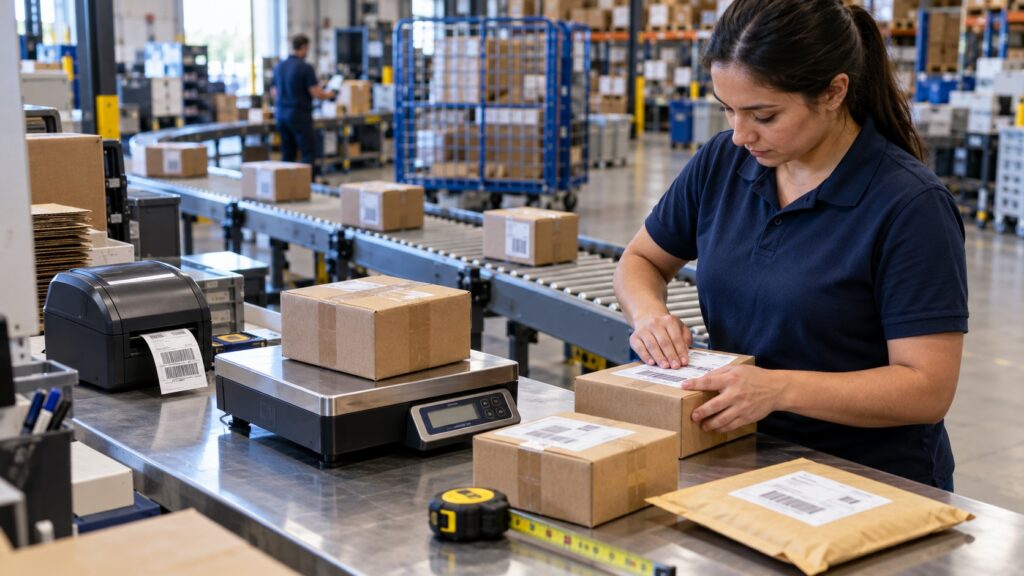
If you sell directly to consumers, almost every order you ship is a small parcel. At hundreds or thousands of orders a month, the carriers you choose, the way you pack, and where you ship from start to shape both your margins and your customer experience.
Here’s how small parcel shipping works, how parcel carriers price small packages, and how growing D2C brands keep it efficient.
What Is Small Parcel Shipping?
Small parcel shipping means sending individual, relatively light packages through a parcel carrier’s network instead of moving goods on pallets. Each small parcel package (a box, a poly mailer, or a padded envelope) gets its own label and tracking number. The carrier picks it up, sorts it through its hubs, and handles last-mile delivery to the customer’s door.
If you’ve wondered what parcel shipping is in practical terms, that’s it: one order, one package, one address, which is why it’s the default for ecommerce.
What Counts as a Small Parcel?
There’s no single industry definition. Each carrier sets its own small parcel size and weight limits. USPS caps packages at 70 lbs and 108 inches in combined length and girth, while UPS and FedEx accept parcels up to 150 lbs and 165 inches in combined length and girth. Check current limits before you build packaging around them.
Most D2C small parcels sit far below those limits, so the number to watch is dimensional (DIM) weight. Carriers bill on the actual weight or a weight calculated from the box’s dimensions, whichever is greater, so a light product in an oversized box can cost as much to ship as a heavy one.
Small Parcel Shipping vs. Freight
Freight moves palletized goods through LTL (less-than-truckload) or full truckload carriers, usually to a business with a loading dock, while small parcel shipping moves small shipments to many different addresses. PSI handles both, including LTL and full truckload for B2B and retail orders, as long as D2C remains the core of the business.
How Small Parcel Shipping Works
Behind every small parcel is a short, repeatable process. When you outsource ecommerce fulfillment to a 3PL, it usually looks like this:
- The order syncs from your online store into the warehouse management system.
- Items are picked and packed into the right box or mailer. This pick and pack step is where package size, and therefore cost, gets decided.
- The package is weighed, measured, and assigned a carrier and service level.
- A label prints, and the parcel joins the day’s outbound volume for carrier pickup.
- Tracking flows back to your store so your customer knows the order is on its way.
Choosing Small Parcel Carriers
The right mix of parcel carriers depends on what you sell, how much it weighs, and where your customers are. Most growing brands use more than one.
National Parcel Carriers: USPS, UPS, FedEx, and DHL
USPS is often a strong fit for lightweight residential deliveries. UPS and FedEx run extensive ground and express networks and handle heavier small parcels well. DHL is best known for international delivery. Among small package shippers, none is universally the cheapest or fastest; it depends on each package’s weight, dimensions, and destination.
Amazon as a Shipping Solution
Amazon also works as a parcel carrier, much like UPS or FedEx: daily trailer pickup, consumer-facing tracking, and photo confirmation of delivery. PSI is one of a limited number of 3PLs approved to offer Amazon as a shipping solution, and clients don’t need a seller-fulfilled prime setup to use it. For many small parcels, it’s a strong option alongside the traditional small parcel carriers.
Regional Carriers
Regional carriers serve one part of the country. If many of your customers are concentrated there, they can compete on price for those zones, but you still need a national carrier for everything else.
What Drives Parcel Shipping Cost?
Parcel shipping cost comes down to a handful of variables:
- Weight: actual weight or dimensional weight, whichever is higher.
- Dimensions: bigger boxes cost more to ship, even when the product inside is light.
- Distance: carriers price by zone, so the farther a package travels, the more it costs.
- Service level: ground services cost less than expedited ones.
- Surcharges: residential delivery, fuel, oversize, and peak-season fees all add up.
- Volume: shippers that move more parcels can access better carrier pricing.
You can’t control where your customer lives, but you can control packaging and where your inventory sits. For more on those levers, see our guide on how to reduce shipping costs.
Small Parcel Shipping Tips for Growing D2C Brands
Right-Size Every Package
Match box and mailer sizes to your products so you aren’t paying to ship air or triggering DIM weight charges. PSI can source right-sized shipping boxes and mailers through its manufacturer network and have them delivered straight to the warehouse that fulfills your orders.
Compare Carriers on Every Order
Weight, size, and destination change which carrier and service level makes the most sense for each package. A fulfillment partner with deep carrier expertise makes that call order by order instead of defaulting to one carrier out of habit.
Ship Closer to Your Customers
Zones drive cost and transit time. PSI ships from its warehouse in Norcross, Georgia, and through a PSI-managed network of partner warehouses in California, Massachusetts, and Ottawa, Ontario. You keep one customer service team, one invoice, and one login, while orders ship from the location closest to your customers.
Keep Tracking Flowing to Your Store
Connect your store directly to your fulfillment partner so orders flow in and tracking flows back automatically, with no manual uploads. See our platform integrations for the ecommerce platforms and marketplaces we connect with.
Small Parcel Fulfillment with PSI
Small parcel fulfillment is what PSI is built for. We work with high-volume, small-parcel D2C brands, with a focus on consumables like cosmetics, health and beauty, and supplements, and we bring deep carrier expertise, Amazon as a shipping option, and transparent pricing with no nickel-and-diming.
PSI is family-owned and has been in business since 1986, and you work directly with the owners from your first conversation. Request a fulfillment cost analysis and we’ll turn around a business case showing your projected invoice and shipping savings within 24 to 48 hours, or talk to our team.
Small Parcel Shipping FAQs
Can you ship small parcels internationally?
Yes. USPS, UPS, FedEx, and DHL all offer international parcel services. You’ll need customs documentation, and duties, taxes, and transit times vary by destination country.
What is the difference between a parcel and a package?
The terms are mostly interchangeable. Carriers use “parcel” for individually labeled packages moving through their network, as opposed to palletized freight.
Are small parcel shipments insured?
Most carriers include limited liability coverage on standard services, and you can declare a higher value or buy additional coverage for expensive items. Terms differ by carrier and service.
How many orders a month do I need before outsourcing small parcel fulfillment?
There’s no universal number, but outsourcing usually makes sense once shipping starts pulling time away from growth. PSI typically works with brands shipping around 500 or more orders a month, with some flexibility for promising, growing brands.
What does small parcel shipping mean?
Small parcel shipping means sending individual packages, such as boxes, poly mailers, or padded envelopes, through a parcel carrier’s network rather than on pallets. Every parcel gets its own label and tracking number, moves through the carrier’s sorting hubs, and is delivered to a single address. That is why it is the standard way ecommerce orders reach customers.
How much does it cost to ship a small parcel?
There is no flat price for a small parcel, because the cost depends on the package and where it is going. Carriers price each parcel on its billable weight, its dimensions, and the zone it travels to, then factor in the service level (ground or expedited) and surcharges for residential delivery, fuel, or peak season. Shippers moving higher volumes can also access better carrier pricing.
How big can a small parcel be?
Each carrier sets its own limits. USPS accepts packages up to 70 lbs and 108 inches in combined length and girth, while UPS and FedEx take parcels up to 150 lbs and 165 inches. Most D2C orders sit well below those caps, and carriers do update their limits, so confirm current figures before designing packaging around them.
Which carrier is cheapest for small parcels?
No single carrier is the cheapest for every small parcel. USPS is often competitive for lightweight residential deliveries, UPS and FedEx tend to handle heavier parcels well, and regional carriers can undercut national rates within their own zones. Amazon is also a strong option for many small parcels. The cheapest choice depends on each package’s weight, dimensions, and destination, so comparing carriers order by order pays off.
Do carriers charge by size or weight?
Carriers charge by whichever is greater: the parcel’s actual weight or its dimensional (DIM) weight, which is calculated from the box’s length, width, and height. A light product packed in an oversized box can therefore cost as much to ship as a heavy one. Matching box and mailer sizes to your products is the simplest way to avoid DIM weight charges.
What is the difference between small parcel and freight shipping?
Small parcel shipping sends individually labeled packages to many different addresses, usually homes, while freight moves palletized goods through LTL or full truckload carriers, typically to a business with a loading dock. D2C orders almost always ship as small parcels, and freight is used for bulk shipments such as B2B and retail orders.