Key Takeaways
- Outsourced logistics and fulfillment are handled by a third-party provider (receiving, storage, pick and pack, shipping, and returns) while you focus on the business.
- Five clear wins: cost control, scale, speed, and time back.
- Look for clear pricing, real carrier expertise, and someone who answers the phone.
- Honest 3PLs win by telling you if you are not a fit, then proving the numbers.
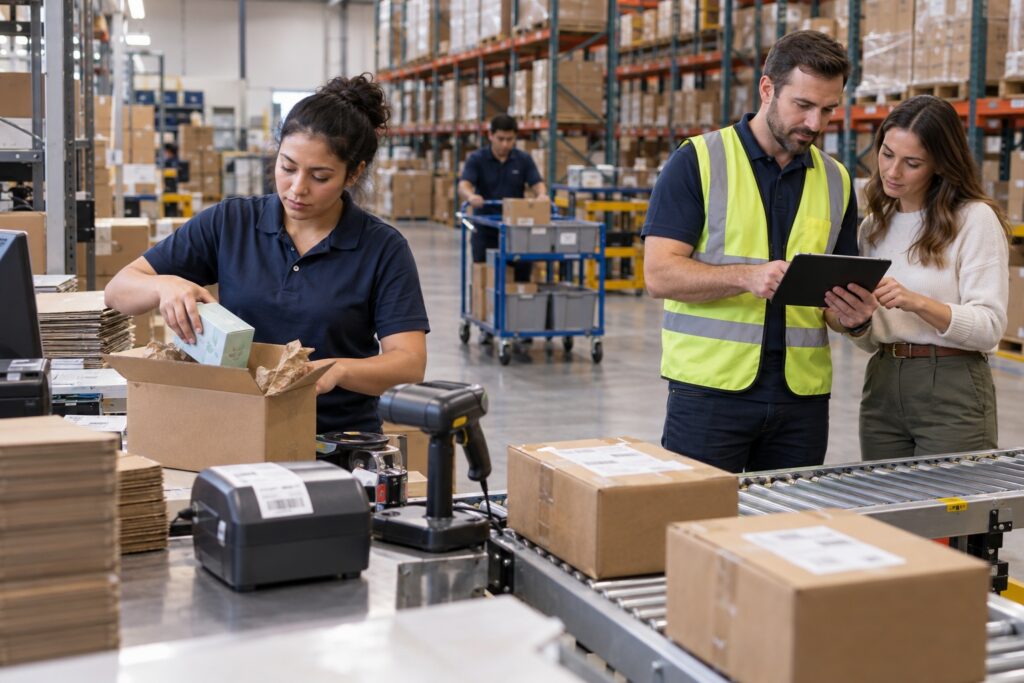
To outsource fulfillment is to hand the storage, picking, packing, and shipping of your orders to a specialist so you can get back to building your brand. For a growing ecommerce company, it is often the difference between a founder who tapes boxes at midnight and one who spends that time on the next product launch.
It matters more than it used to. Ecommerce now makes up roughly 16% of all US retail sales and is climbing faster than retail overall, which means more orders, more packages, and more nights spent at the packing table.
Between January and March 2026, U.S. retail ecommerce sales reached more than $326 billion, according to Statista. For growing brands, that volume makes fast, accurate fulfillment harder to treat as a side task. At some point, doing it all yourself stops being thrifty and starts capping your growth.
What Is Outsourced Fulfillment?
Outsourcing fulfillment is the practice of partnering with a third-party logistics (3PL) provider to run your order fulfillment operation, from the moment inventory arrives at the warehouse to the moment a package lands on your customer’s doorstep. Instead of leasing space, buying equipment, and hiring a shipping team, you pay a provider that already has all three.
In plain terms:
✅ You own the product and the customer.
✅ Your 3PL owns the logistics processes.
That split is the whole point of outsourced order fulfillment; you keep what makes your brand yours and let a specialist handle the boxes.
A typical outsourced setup covers:
- Receiving and storage: Inventory is checked in, counted, and shelved.
- Pick and pack: The right items are pulled and packed for each order.
- Shipping: Orders go out on negotiated carrier rates.
- Returns: Items are inspected, restocked, and refunded.
5 Benefits When You Outsource Order Fulfillment
Outsourcing works best when the partner can improve supply chain performance, not just take boxes off your hands. The case for outsourced order fulfillment comes down to five practical wins.
1. Lower, more predictable costs
You stop paying rent, utilities, equipment, and a warehouse payroll. Warehouse labor is not cheap. A 3PL spreads those fixed costs across many clients. Then passes volume shipping discounts back to you.
2. Scalability without the scramble
Order volumes swing hard around promotions and holidays. During the 2024 holidays, online sales grew more than twice as fast as total retail. A 3PL adjusts capacity for those peaks, so you are not hiring temps in November and cutting them in January.
3. Faster, more reliable delivery
A provider with inventory positioned near your buyers shortens transit time and lowers cost. After all, reliable delivery is what earns the second order.
4. Time back for the work only you can do
Every hour not spent packing is an hour for product, marketing, and customers. With fulfillment off your plate, you can put more energy into the decisions that move your business forward. Your team can focus on revenue-generating work instead of the daily tasks required to keep orders moving.
5. Expertise and returns handling
Returns are already a major workload, reaching $890 billion in 2024, and fraud makes them even harder to manage. With 93% of retailers calling fraud a significant issue, a 3PL with a real returns process helps protect your time, margin, and customer experience.
In-House vs. Outsourced Fulfillment
Let’s be honest here. Both models work. The right one depends on your volume, your margins, and how much control you want.
| Factor | In-House Fulfillment | Outsourced Fulfillment |
|---|---|---|
| Upfront cost | High: space, equipment, staff | Low: pay per use |
| Control | Full | Shared with your provider |
| Scalability | Limited | Adjusts with demand |
| Shipping rates | Your own retail rates | Discounted volume rates |
| ⭐ Best fit | Low volume, custom handling | Growing, high-volume brands |
Plenty of brands run a hybrid for a while: self-fulfilling one core SKU and outsourcing the rest, before moving everything to a 3PL.
When to Switch to a 3PL
There is no universal number, but a few signals make the case for ecommerce fulfillment outsourcing hard to ignore:
- Rising volume: Many brands find outsourcing pays off once they ship around 500 orders a month, every month.
- Time drain: When packing crowds out product and marketing, the real cost is your growth.
- Seasonal peaks: If Q4 means chaos and overtime, a partner who scales is worth it.
- Shipping costs: If you pay near-retail rates, a 3PL’s negotiated pricing can pay for itself.
- New regions: Reaching both coasts quickly from a single location is hard to do alone.
What Switching to a 3PL Actually Looks Like
Moving to outsourcing order fulfillment is less disruptive than most founders fear when the provider conducts a proper onboarding process. The good ones start with questions, not a contract.
A switch to PSI starts with a short intake questionnaire and an intro call, a look at your recent order export, and a free fulfillment cost analysis that shows your projected invoice and savings within 24 to 48 hours. You will typically hear back from us within a day.
PSI has handled ecommerce fulfillment, subscription and batch orders, and kitting and assembly for growing brands since 1986.
See What Outsourcing Could Save You, Before You Commit
You should not have to guess whether outsourced fulfillment pencils out. The fastest way to find out is to put your actual numbers next to what a 3PL would charge.
If you are weighing the move, we can help you see the benefits in black and white before you change a thing.
Get your free fulfillment cost analysis
Outsourced Fulfillment FAQs
What does an outsourced fulfillment provider actually do?
A provider receives and stores your inventory, picks and packs each order, ships it on discounted carrier rates, and processes returns. You keep control of your product, pricing, and customer relationships while they run the warehouse day-to-day.
How much order volume do I need before outsourcing makes sense?
There is no hard rule, but many brands find it pays off around 500 orders a month, shipped consistently. The clearer trigger is when fulfillment starts limiting growth or costing more than a 3PL would charge.
Does outsourcing fulfillment actually cost less than doing it yourself?
Often, yes. You trade fixed costs like rent, equipment, and payroll for per-use fees and volume shipping discounts. Savings depend on your volume and product, so ask any provider for a custom cost analysis first.
Can a 3PL handle a subscription box business?
Yes. A brand shipping 2,000 curated boxes on the first of each month, for example, is a strong fit for batch fulfillment and kitting, as long as the provider has real experience with recurring, scheduled runs.